
Page last updated September 15, 2026
In 2025, more than 20 changes to Colorado’s Long-Term Services and Supports (LTSS) system were proposed by the state’s Department of Health Care Policy & Financing (HCPF) to offset federal Medicaid cuts and state budget challenges. These changes have had a big impact on our community, affecting many of the supports that people with disabilities rely on to receive the care they need and engage with their community.
It’s crucial for people with disabilities to stay informed so they can prepare for changes to their services, make alternate plans if needed, and request exceptions to rules when it makes sense. To help, we’ve compiled a list of every change that’s being implemented as part of this effort and what you need to know about each. We’ll be updating this page frequently, so check back often to stay current on the changes that impact you.
Make your voice heard: Through ongoing feedback opportunities, you can share your perspective with HCPF and help shape rules as they go into effect.
- Click here to find open feedback opportunities for the changes listed below.
- Click here to find open public comment opportunities for any actions that require 1915(c) HCBS waiver changes.
- Both pages are updated regularly, so be sure to check back in the future for additional feedback opportunities.
Click the links below to jump to different sections of this page.
- Click here to view implemented changes
- Click here to view changes rolling out
- Click here to view changes coming soon
- Click here to view paused changes
- Click here to view withdrawn changes
Implemented

Click the image above to view the fact sheet
Eliminating the Nursing Facility Minimum Wage Payments
This change ended supplemental, or additional, payments that the government was providing to nursing facilities. The payments helped nursing facilities pay their employees at least $15 an hour when state minimum wage was still below $15 an hour.
The program was expected to end in the state’s 2026-2027 fiscal year. This change ended the program earlier, in August 2025, with Colorado’s state minimum wage rising above $15 an hour in January 2026.
Who was affected? Nursing facilities
When did this change take place? August 2025. Payments did not go out in Spring 2026.

Click the image above to view the fact sheet
Delay Presumptive Eligibility for Long-Term Services and Supports
Under this change, HCPF delayed the launch of its new Long-Term Services and Supports (LTSS) Presumptive Eligibility Program by about one year. In other words, instead of beginning in 2026, the new program is expected to begin in July 2027. The new program will apply to adults with disabilities who:
- have submitted a long-term care Medicaid application, and
- appear to be eligible for LTSS
Through the program, these adults will be able to start receiving some LTSS services before their full application has been approved.
Who is affected? Adults with disabilities applying to receive LTSS should be aware that the Presumptive Eligibility program will not begin in 2026. It is now expected to begin July 1, 2027.
When did this change take place? October 2025

Click the image above to view the second factsheet

Click the image above to view the first fact sheet
Community Connector: Rate Reduction (January) and Align Community Connector Rate with Supported Community Connections (April)
These changes decreased the pay rate for providers who provide Community Connector Services. These services are accessed through the Children’s Extensive Support (CES) and Children’s Habilitation Residential Program (CHRP) waivers and support children one-on-one to safely access and engage with the community.
The first reduction took effect in January 2026, decreasing the Community Connector pay rate to about $10.51 per 15-minute unit for providers in Denver and $10.23 per 15-minute unit for providers outside of Denver.
The second reduction took effect in April 2026, decreasing the rate to about $7.83 per 15-minute unit in Denver and $7.71 per 15-minute unit outside of Denver.
Due to a separate sustainability action, all provider rates, including rates for Community Connector, were reduced by an additional 2% across the board. Because of this decrease, the pay rate for Community Connector services is now roughly $7.67 per 15-minute unit in Denver and $7.56 per 15-minute unit outside of Denver. See “Across the Board Provider Rate Reductions (1.6% and 2%)” below for additional detail.
Who is affected? Providers of Community Connector services for children on CES or CHRP waivers.
When did this change take place? The first rate reduction took place in January 2026. The second took place in April 2026.

Click the image above to view the fact sheet
Across the Board Provider Rate Reductions (1.6% and 2%)
This change:
- Rolled back a 1.6% pay rate increase that providers received in July 2025.
- Implemented an additional 2% pay rate decrease across the board for most Medicaid providers.
Who was affected? Most Medicaid providers, including Case Management Agencies, as well as Consumer-Directed Attendant Support Services (CDASS) members receiving allocations to direct their own care.
When did this change take place? The 1.6% reduction took effect October 1, 2025. The additional 2% reduction took effect July 1, 2026.

Click the image above to view the fact sheet
Reduce Developmental Disabilities Waiver Churn Enrollment
This change reduced waiver churn enrollment onto the Developmental Disabilities (DD) waiver by 50%. Previously, for every person who disenrolled from the DD waiver, one person was moved off the waitlist and authorized to enroll in the waiver. Under the change, for every two people who disenroll from the DD waiver, one person is moved off the waitlist and authorized to enroll in the waiver.
Who is affected? Members currently on the DD Waiver waitlist and those seeking to be added to the waitlist in the future.
When did this change take place? July 1, 2026

Click the image above to view the fact sheet
Remove Equine Services in Home and Community Based Services
This change removes Adaptive Therapeutic Equine Activities from HCBS waivers.
These services were added as a specialized therapy option under HCBS waivers in 2024, but there were challenges in launching this new option, so it was never fully implemented. Because of that, no Medicaid members were accessing this service under HCBS waivers yet.
This change stops the plan to implement this option for now. Going forward, members will continue to be unable to access these services under HCBS waivers.
Who is affected? Members enrolled in an HCBS waiver who had planned to access this service when implementation was finished should no longer plan to access the service through their HCBS waiver.
When did this change take place? The effective date for this change is July 1, 2026, pending federal approval.
Rolling Out Now
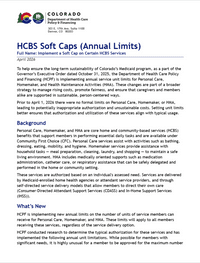
Click the image above to view the fact sheet
Implement a Soft Cap on Certain HCBS Services
This change established yearly limits, or service caps, for three categories of services. In other words, members can no longer receive approval for more than a certain number of yearly units for each service, unless they qualify for an exception. The new limits are as follows:
- Personal Care (includes assistance with bathing, dressing, etc.): 10,000 units/year (~6.5 hours/day)
- Homemaker (includes assistance with meal preparation, cleaning, etc.): 4,500 units/year (~3 hours/day)
- Health Maintenance Activities (HMA) (includes medically oriented support such as medication administration, catheter care, etc.): 19,000 units/year (~13 hours/day)
Importantly, if members believe they qualify for an exception to this new rule, they should contact their Case Management Agency to ask about submitting an exceptions request.
Click here to read more about this change and here to read more about the exceptions process.
Who is affected? All Medicaid members who receive care under the Personal Care, Homemaker, or HMA service categories.
When did this change take place? April 1, 2026. Case managers will meet with all affected members (either at a Continued Stay Review or Scheduled Monitoring) to apply this change by November 30, 2026.
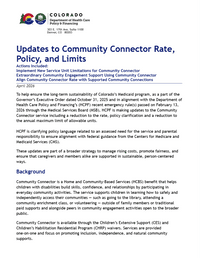
Click the image above to view the fact sheet
Implement New Service Unit Limitations for Community Connector
This change decreases the maximum number of Community Connector service hours a member can receive each year. Under the change, members will be approved to receive no more than 1,040 fifteen-minute units (260 hours) of Community Connector services per year. Previously, the limit was 2,080 fifteen-minute units (520 hours).
Click here to read more about this change.
Who is affected? Medicaid members on the CES and CHRP waivers who receive Community Connector services.
When did this change take place? Effective April 1, 2026, this change goes into effect for the member’s next certification period beginning on or after April 1, 2026.
Click the image above to view the fact sheet
New Community Connector for Extraordinary Support Needs
Under this change, Community Connector services will only be approved for members that are assessed to have an extraordinary community engagement need for their age. There is no age minimum for members wishing to access the service, but the member’s need for support must be substantially greater than typical Parental or Legal Guardian Responsibilities. Because of this, authorization for Community Connector services is expected to be rare for children in early childhood.
Click here to read more about this change.
Who is affected? Members on the CES or CHRP waivers wishing to access Community Connector services.
When did this change take place? April 2026. Case managers will meet with all affected members (either at a Continued Stay Review or Scheduled Monitoring) to assess members for need by September 30, 2026, for an effective date of change on or before November 30, 2026.
Click the image above to view the fact sheet
Implement a Cap on Weekly Homemaker Hours for Legally Responsible Persons
This change decreases the limit on the number of reimbursable Homemaker service hours that a Legally Responsible Person (LRP)* can provide to a single member each week. Under the change, LRPs will be approved to provide no more than 7 hours of Homemaker services to a member per week. Previously, the limit was 10 hours per week.
- If a member receives Homemaker services from more than one LRP, the combined total of service hours provided by LRPs cannot be more than 7 hours.
- If a member is authorized to receive more than 7 hours of Homemaker services per week, the remaining hours must be provided by a non-LRP caregiver.
* An LRP is a person legally responsible for the care of an individual. For children, a parent or guardian is considered an LRP. For adults, only a spouse is considered an LRP.
An earlier version of this rule went into effect in April 2026 and imposed a cap of 5 hours per week per LRP (up to 2 LRPs). This rule updated those requirements beginning in June 2026.
Click here to read more about this change.
Who is affected? Medicaid members who receive Homemaker services provided by an LRP.
When did this change take place? June 2026. Case managers will meet with all affected members (either at a Continued Stay Review or Scheduled Monitoring) to revise Person-Centered Support Plans by September 30, 2026, for an effective date of change on or before November 30, 2026.
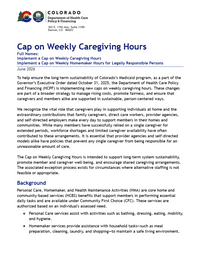
Click the image above to view the fact sheet
Implement a Cap on Weekly Caregiving Hours
This change limits the number of reimbursable care hours that a single caregiver can provide to a single member in one week. Under the change, a single caregiver may be reimbursed for no more than 56 hours of care per member per week. The following services count toward the weekly total: Personal Care, Homemaker, Health Maintenance Activities (HMA), Long-Term Home Health (LTHH)-Home Health Aide, and LTHH-Nursing Services.
Members who are approved to receive more than 56 hours of these services per week can still receive those services. However, the hours must be divided among multiple caregivers so that no caregiver is providing more than 56 hours of reimbursable care per week.
Importantly, if members believe they qualify for an exception to this new rule, they should contact their Case Management Agency to ask about submitting an exceptions request. Click here to find more information about the exceptions process for this change.
Who is affected? Members who receive more than 56 hours combined of Personal Care, Homemaker, HMA, LTHH-Home Health Aide, and LTHH-Nursing services per week, and their caregivers.
When did this change take place? This change is being implemented in phases. As of July 1, 2026, caregivers can be reimbursed for no more than 84 hours of the above services per member per week. On January 1, 2027, the limit will be reduced to 70 hours per member per week. On July 1, 2027, the limit will be reduced to 56 hours per member per week.
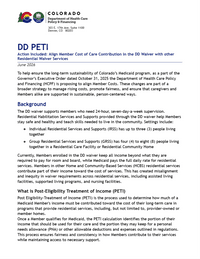
Click the image above to view the fact sheet
Align Member Cost of Care Contribution in the DD Waiver with Other Residential Waiver Services (DD PETI)
This change applies Post-Eligibility Treatment of Income (PETI) for members receiving residential services under the Developmental Disabilities (DD) Waiver. This includes Individual Residential Services and Supports (IRSS) and Group Residential Services and Supports (GRSS).
Under PETI, some members will be asked to use some of their income to help pay for services (in addition to any existing expectations to contribute toward Room & Board). The member will never pay their total income toward services. Instead, money for taxes and personal needs, and money that goes to certain expenses like Room & Board, will be protected from PETI. After the money for protected expenses is set aside, the member will be asked to contribute any remaining income to help pay for services. If no income remains, the member will not be asked to contribute.
PETI has already been in effect for other HCBS waivers that provide residential services, including the Brain Injury (BI), Community Mental Health Supports (CMHS), and Elderly, Blind, and Disabled (EBD) waivers.
Click here to read more about this change.
Who is affected? DD Waiver members receiving residential services are affected. As explained above, some members with little or no income will not be required to help pay for their services.
When did this change take place? Effective August 1, 2026, this change goes into effect for the member’s next certification period beginning on or after July 1, 2026.
Coming Soon
Click the image above to view the fact sheet
Develop a Standardized Rate Tool for Residential Habilitation Negotiated Rates
Members on the Developmental Disabilities (DD) or Children’s Habilitation Residential Program (CHRP) waivers receiving Residential Habilitation Services and Supports are assigned a Support Level based on the extent of their need, which then determines the pay rate for the provider serving the member. For members who have a greater need than is outlined in the highest Support Level, HCPF and the provider agree on a rate that matches the level of support needed (also known as Level 7 rates). This change will develop and implement a new method and tool for setting negotiated rates, making the process more fair and consistent.
Who is affected? The new tool will be used by HCPF, not members or providers. However, members on the DD and CHRP waivers who qualify for Residential Habilitation services requiring negotiated rates, and their providers, should know that this change will factor into the negotiated reimbursement rate.
When does this change take place? The new tool is expected to be active for DD waiver services beginning Fall 2026. It is expected to be active for CHRP waiver services beginning Winter 2027.
Click the image above to view the fact sheet
Colorado Single Assessment Tool Implementation
This change creates a new Colorado Single Assessment (CSA) tool, which will be used for the Level of Care Screen, comprehensive needs assessment, and Person-Centered Support Plan for all LTSS members. The change is meant to make needs assessments more fair and consistent by making sure professionals all use the same rules to evaluate needs.
Who is affected? LTSS members do not have to do anything to prepare for this change, but should know that the new tool will be used for ongoing processes that evaluate their needs.
When does this change take place? This change is expected to go into effect in the 2026-2027 fiscal year.
Click the image above to view the fact sheet
Youth Transitions in DD Waiver
This change ends the choice for youth who are currently enrolled in the Children’s Extensive Support (CES) and Children’s Habilitation Residential Program (CHRP) waivers to automatically enroll in the Developmental Disabilities (DD) Waiver when they turn 18. Instead, members will be added to the DD waiver waitlist at age 18 after they are determined eligible for the waiver by their Case Management Agency.
There will be an exception for youth who are being served by the child welfare system or experiencing emergency criteria.
Click here to read more about this change.
Who is affected? Children enrolled in the CES or CHRP waiver who will turn 18 on or after the implementation date, or whose transition paperwork is not finalized by the implementation date.
When does this change take place? January 1, 2027
Click the image above to view the fact sheet
Establish Private Duty Nursing (PDN) 60-Day Acute Benefit
Currently, Prior Authorization Requests (PARs) are required for Private Duty Nursing (PDN) services provided to members. This change creates a new Acute PDN Benefit that would provide up to 60 days of PDN services coverage for members who are newly accessing these services and do not yet have a PAR finalized. This will support quicker discharges for members moving from acute care settings, such as hospitals, to home and community settings.
Who is affected? Members newly accessing PDN services, such as members seeking discharge from an acute-care setting.
When does this change take place? January 1, 2027, pending federal approval.
Click the image above to view the fact sheet
Establish Private Duty Nursing (PDN) Per Diem Rate
This change creates a new rate for per diem Private Duty Nursing (PDN) services that are provided 24/7. The new rate will be a blend of Registered Nurse (RN) and Certified Nursing Assistant (CNA) rates. The existing individual and group hourly rates will remain available for situations where the criteria described above do not apply.
Who is affected? Providers of 24/7 per diem PDN services.
When does this change take place? From January 1-December 31, 2027, the new rate will be applied to affected members’ services when the member’s PDN Prior Authorization Request (PAR) is renewed, pending federal approval.
Click the image above to view the fact sheet
Adjust Service Durations Per Billable Unit for Long-Term Home Health (LTHH) Services
This change shortens the length of the billable units for Certified Nursing Aide (CNA) services, Physical Therapy (PT), Occupational Therapy (OT), and Speech Language Pathology/Speech Therapy (SLP/ST) provided under Long-Term Home Health (LTHH). CNA services will be billed in 15-minute units, and PT, OT, and SLP/ST services will be billed in 30-minute units.
Importantly, members will still be able to receive the service hours they are approved for. This change only affects how services are billed, with the goal of making billing practices more accurate.
Who is affected? Providers will be affected by the billing change. Members may see changes in how time blocks for services are scheduled.
When does this change take place? January 1, 2027, pending federal approval.
Click the image above to view the fact sheet
Create Group Rates for Certain Community First Choice (CFC) and Long-Term Home Health (LTHH) Services
Group rates refer to the pay rate for providers who are providing the same service in the same setting to multiple members at once (such as laundry or meal prep services, for example). This change establishes a group rate for the following services:
- Community First Choice (CFC): Health Maintenance Activities (HMA) under In-Home Support Services (IHSS), Personal Care services, and Homemaker services
- Long-Term Home Health (LTHH): Certified Nursing Aide (CNA) services
The group rate will be used when the provider is providing the same service in the same setting to multiple members at once. As of November 2025, the group rate is expected to be about 20% lower per person than the individual rate.
Click here to read more about this change.
Who is affected? Providers who provide any of the above services to multiple members at once will be affected. Members may see changes in how services are billed.
When does this change take place? From January 1-December 31, 2027, services for affected members will move to the group rate at the member’s next Continued Stay Review (CSR) or new prior authorization period, pending federal approval.
Paused
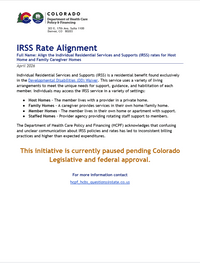
Click the image above to view the fact sheet
Align the Individual Residential Services and Supports (IRSS) Rates for Host Home and Family Caregiver Home
This change would realign the pay rate for family caregiver homes providing Individual Residential Services and Supports (IRSS) under the Developmental Disabilities (DD) Waiver. The change aims to ensure family caregiver homes that do not operate as staffed environments are not billing at IRSS rates intended for staffed environments, but are instead billing at the lower IRSS rate option.
Who is affected? Family caregiver homes that provide IRSS.
When does this change take place? This change has been paused pending further action from the legislature. Members should not experience any changes related to this initiative at this time.
Withdrawn
Reduce Movement Therapy Services to Align with Rate Methodology
This change would reduce providers’ pay rates for Movement Therapy services, which include services like Music Therapy. Importantly, this change was withdrawn after community members advocated for the importance of these services.
Who is affected? The change would have affected Movement Therapy providers, with the potential to have a trickle-down effect on members if providers had to close because of the decreased rates.
When does this change take place? This change has been withdrawn and will not take place.